
Understanding Makharij Al-Huroof: How to Pronounce Arabic Letters
For many non-Arab Muslims living in the West, reciting the Quran presents a unique linguistic challenge. You may recognize the letters and understand the basic vowels, but reproducing the exact sounds can feel like a physical struggle. Letters like ع (‘Ayn) and ح (Haa) might seem impossible to pronounce, simply because these sounds do not exist in the English language.
The key to unlocking beautiful, accurate, and authentic Quranic recitation lies in one foundational science of Tajweed: Makharij Al-Huroof.
Whether you are a beginner taking your first steps into the Arabic alphabet or someone looking to correct years of heavy English-accented recitation, understanding your Makharij is the absolute first step. This guide will break down the anatomy of Arabic pronunciation in a simple, practical way.
What Does “Makharij Al-Huroof” Mean?
Linguistically, the word Makharij (مخارج) is the plural of Makhraj, which means “the place of exit” or “the point of origin.” Huroof (حروف) means “letters.”
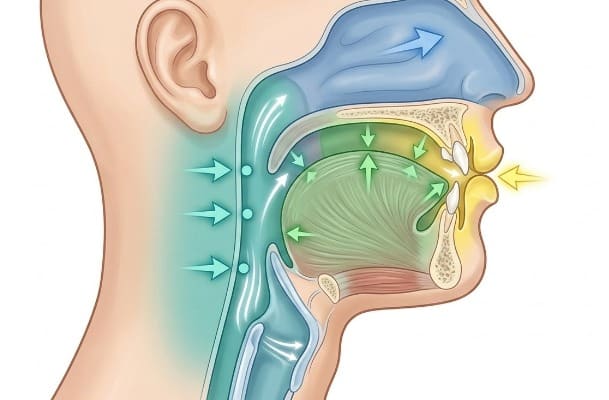
In the science of Tajweed and phonetics (place of articulation), Makharij Al-Huroof refers to the specific physical location in the mouth, throat, or nasal cavity where the sound of an Arabic letter is formed. If you do not articulate a letter from its exact Makhraj, it will either sound distorted or transform entirely into a different letter, which can change the meaning of the Quranic verse (Lahn Jali).
The Golden Trick: How to Find the Makhraj of Any Letter
Scholars of Tajweed use a brilliant, centuries-old trick to help students find the exact origin point of any letter. You can try it right now:
-
Put a Fatha (an “a” sound) on the letter Hamza (أَ).
-
Put a Sukoon (a resting sound) on the letter you want to test.
-
Pronounce them together and notice exactly where the sound naturally cuts off in your mouth.
For example, to find the Makhraj of the letter Baa (ب), say: “Ab!” (أَبْ). You will notice that the sound is physically stopped by your two lips pressing together. Therefore, the lips are the Makhraj of Baa.
The 5 Major Areas of Articulation (Al-Makharij Al-Ammah)
To make learning manageable, Tajweed scholars divided the human vocal tract into 5 main areas. From these 5 areas, 17 specific articulation points emerge, producing all 28 Arabic letters.
1. Al-Jawf (The Empty Space of the Mouth and Throat)
Al-Jawf is the hollow, empty space inside your throat and mouth. No physical parts touch to make these sounds; they are simply vibrations of air. This area is exclusively for the three Madd (elongation) letters:
-
Alif (ا) preceded by a Fatha.
-
Waw (و) preceded by a Damma.
-
Yaa (ي) preceded by a Kasra. When you say the word Nooh (نوح), the prolonged “oo” sound originates in the Jawf.
2. Al-Halq (The Throat)
This is the area that English speakers struggle with the most, as English relies very little on deep throat sounds. The throat is divided into three sections:
-
The Deepest Part of the Throat (Aqsa Al-Halq): Near the vocal cords. Produces Hamza (ء) and Haa (هـ).
-
The Middle of the Throat (Wasat Al-Halq): You must physically squeeze your throat muscles to produce the sharp ‘Ayn (ع) and the raspy Haa (ح).
-
The Top of the Throat (Adna Al-Halq): Just behind the uvula. Produces the gargling sound of Ghayn (غ) and the snoring sound of Khaa (خ).
3. Al-Lisan (The Tongue)
The tongue is the most complex articulation area, responsible for 18 distinct letters. It interacts with the teeth, the gums, and the roof of the mouth (palate).
-
Deep Tongue: Letters like Qaf (ق) and Kaaf (ك).
-
Middle Tongue: Letters like Jeem (ج), Sheen (ش), and the consonant Yaa (ي).
-
Sides of the Tongue: The infamous and difficult letter Dhaad (ض), which is produced by pressing the side of the tongue against the upper molars.
-
Tip of the Tongue: Interacting with the front teeth and gums to produce letters like Taa (ت), Daal (د), Saa (ث), and Zaal (ذ).
4. Ash-Shafatayn (The Two Lips)
This is the easiest section for beginners.
-
Pressing the lips together produces Baa (ب) and Meem (م).
-
Making a circle with the lips produces the consonant Waw (و).
-
Resting the top teeth on the bottom lip produces Faa (ف).
5. Al-Khaishum (The Nasal Cavity)
Unlike the other areas, the nasal cavity does not produce specific letters, but rather a characteristic sound called Ghunnah (a nasal hum). This sound is an integral part of pronouncing the letters Meem (م) and Noon (ن), especially when applying advanced Tajweed rules like Idgham or Ikhfa.
Why English Speakers Must Unlearn Their Habits
The biggest mistake non-Arab adults make is “mapping” Arabic letters to the English alphabet. For instance, reading the heavy Arabic Taa (ط) exactly like the English “T”, or the heavy Saad (ص) like the English “S”.
English letters are generally light and produced near the front of the mouth. Arabic, however, is a deeply phonetic language that utilizes the entire vocal tract. To pronounce Makharij correctly, you have to break your English speaking habits and train entirely new muscles in your throat and jaw.
What’s the Difference in Tajweed?
Practical Steps to Master Your Makharij
-
Use a Mirror: When practicing letters that involve the lips or the tip of the tongue (like ث or ذ), look in a mirror to ensure your tongue is physically touching the edge of your top teeth.
-
Listen and Repeat: Do not guess the sound. Listen to a master reciter (like Sheikh Al-Husary) playing a single letter, and mimic the sound immediately.
-
Seek Expert Feedback: Because you cannot see inside your own throat, it is impossible to know if you are producing the ‘Ayn (ع) from the correct spot without trained ears listening to you. For serious students, enrolling in structured online Tajweed courses with native Arab scholars is the most effective way to correct ingrained pronunciation errors.
Conclusion
Understanding Makharij Al-Huroof is the gateway to reciting the Quran beautifully and accurately. It requires patience, physical muscle training, and consistent practice. Do not be discouraged if a certain letter takes weeks to master. The physical effort you exert to perfect the pronunciation of Allah’s words carries immense spiritual reward. Keep practicing, keep listening, and your tongue will eventually unlock the beautiful rhythm of the Arabic language.