
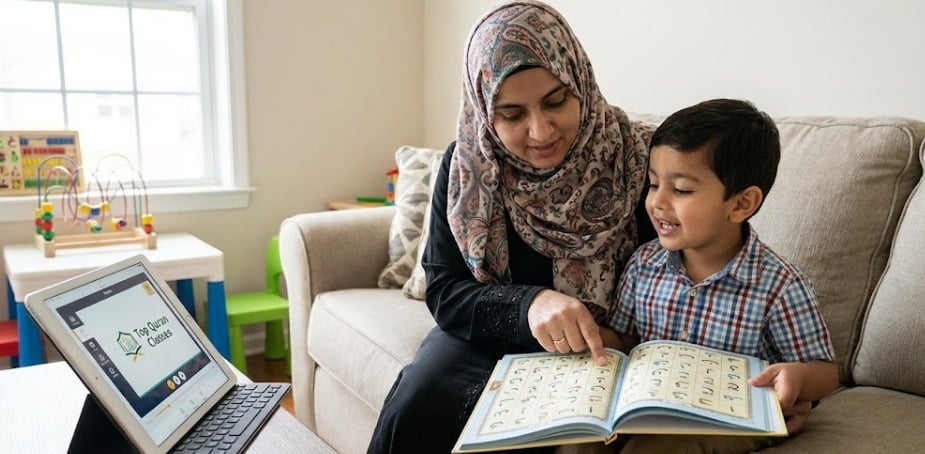
What is the Right Age to Start Learning Noorani Qaida? A Guide for Muslim Parents
Raising a Muslim child in the United States is a deeply rewarding yet challenging endeavor. Amidst school, extracurricular activities, and the fast-paced Western lifestyle, instilling a strong Islamic identity is often the top priority for parents. The cornerstone of this identity is a profound connection to the Holy Quran.
For most non-Arab Muslim children, this beautiful journey begins with a foundational booklet known as the Noorani Qaida. But a question that constantly echoes in the minds of parents is: What is the right age to start learning Noorani Qaida? Push too early, and the child might feel overwhelmed. Wait too long, and they might struggle with Arabic pronunciation as their vocal habits form around the English language.
This comprehensive guide will explore the ideal age to introduce the Noorani Qaida, the signs that your child is ready, the immense benefits of starting early, and how modern online platforms can make this process seamless and engaging for your family.

What Exactly is the Noorani Qaida?
Before determining the right age, it is essential to understand what the Noorani Qaida is. Compiled centuries ago by Sheikh Noor Muhammad Ludhianvi, the Noorani Qaida is a structured, step-by-step curriculum designed specifically for non-native Arabic speakers.
It serves as the ultimate bridge between knowing nothing about the Arabic language and reading the Holy Quran with perfect Tajweed. The curriculum is brilliantly sequenced:
-
The Alphabet (Huroof): Recognizing individual Arabic letters and their correct articulation points (Makharij).
-
Joint Letters: Learning how letters change shape when connected at the beginning, middle, or end of a word.
-
Vowels (Harakat): Understanding Fatha, Kasra, and Damma.
-
Advanced Rules: Gradually introducing Tanween, Sukoon, Shaddah, and basic Tajweed rules like Madd and Ghunnah.
By the time a student finishes the Qaida, they are fully equipped to open the Mushaf (the Quran) and read any word confidently.
The Golden Question: What is the Ideal Age?
Child development experts and seasoned Quran teachers generally agree that the ideal age to start learning Noorani Qaida is between 4 and 5 years old. Why this specific window? At four to five years of age, a child’s brain is like a sponge. They are currently in the critical period of language acquisition. During this phase, neuroplasticity is at its peak, allowing children to absorb new phonetic sounds, accents, and rules with remarkable ease.
However, it is crucial to remember that age is just a number. Every child is unique, and their developmental milestones vary. Some children might show readiness at 3.5 years old, while others might not be fully ready to sit for a lesson until they are 6.
5 Signs Your Child is Ready for Noorani Qaida
Rather than strictly following a calendar, watch for these developmental cues to gauge if your child is ready to begin their formal Quranic education:
1. Clear Native Language Speech
If your child can speak English (or your native language) clearly, formulate complete sentences, and articulate sounds without major speech delays, their vocal cords and tongue muscles are developed enough to tackle Arabic letters.
2. Ability to Recognize Basic Shapes
The Arabic alphabet relies heavily on visual recognition (e.g., distinguishing between a letter with one dot on top versus two dots below). If your child can easily identify basic shapes, colors, and English letters, they will adapt quickly to Arabic text.
3. A 15-Minute Attention Span
Formal learning requires a degree of focus. If your child can sit still and engage in a single activity—like coloring, building blocks, or listening to a storybook—for 10 to 15 minutes, they are ready for short, interactive Qaida lessons.
4. Following Two-Step Instructions
Can your child follow a command like, “Please pick up the book and put it on the table”? Comprehending and executing multi-step instructions is vital for interacting with a Quran teacher.
5. Natural Curiosity About the Quran
If your child mimics your prayer, tries to hold the Mushaf, or asks questions when you are reciting the Quran, this intrinsic motivation is a perfect green light to introduce them to the Qaida.
The Immense Benefits of Starting Early
Starting the Noorani Qaida between the ages of 4 and 5 offers unparalleled advantages that will shape your child’s relationship with the Quran for decades to come.
Mastering Difficult Articulation Points (Makharij)
The Arabic language contains heavy and throaty letters (like Khaa, Ghayn, and Dhaad) that do not exist in the English phonetic system. When an adult tries to learn these sounds, they must unlearn decades of English speaking habits. A 5-year-old has no such habits. Their vocal apparatus is flexible, allowing them to mimic native Arab sounds perfectly and naturally.
Building a Lifelong Spiritual Habit
When Quran reading is integrated into a child’s daily routine from a young age, it becomes as normal as brushing their teeth or going to school. It ceases to be a “chore” and becomes a foundational pillar of their daily life.
Boosting Cognitive Development
Studies have shown that bilingual children or children who learn to read a second script early on have better memory, improved problem-solving skills, and higher overall cognitive flexibility.
The US Parent’s Dilemma: Finding the Right Time and Tutor
Understanding when to start is only half the battle. The other half is how to start. For Muslim parents in the USA, finding a qualified, patient teacher who understands child psychology can be incredibly difficult. Weekend Islamic schools are great for socialization, but placing a 5-year-old in a class with 15 other children often results in them getting only two minutes of reading time per week. This severely slows down their progress and can cause them to lose interest.
This is where the digital revolution of Islamic education steps in. Today, you can enroll your child to learn Noorani Qaida and Tajweed online from the absolute comfort of your home.
Why Online Classes are Perfect for Young Beginners
-
One-on-One Attention: The teacher focuses entirely on your child’s mouth movements, ensuring zero mistakes become permanent habits.
-
Gamified Learning: The best platforms use digital whiteboards, colorful slides, and interactive games to keep a 5-year-old glued to the screen.
-
Native Arab Tutors: Your child learns the purest pronunciation directly from certified scholars in the Middle East.
-
Convenience: No more rushing through traffic. You can schedule a 30-minute class at a time when your child is most energetic and focused.
4 Tips for a Successful Noorani Qaida Journey
If you have decided that your child is ready, keep these tips in mind to ensure a positive experience:
-
Keep it Short: For a 4 or 5-year-old, a 25 to 30-minute class is the absolute maximum. Do not force hour-long sessions, as this leads to burnout.
-
Consistency Over Volume: Studying for 15 minutes every single day is vastly superior to studying for two hours once a week. Consistency builds muscle memory.
-
Positive Reinforcement: Shower them with praise, stickers, and small rewards when they master a new page. The goal is to associate the Quran with joy, not stress.
-
Do Not Compare: Your child might take three months to finish the Qaida, or they might take a year. Do not compare their progress to their siblings or friends. Patience is key.
Frequently Asked Questions (FAQ)
1. Is 3 years old too early to start Noorani Qaida? For formal learning, 3 years old is generally too early, as their attention span and speech are still developing. However, you can casually introduce them to the Arabic alphabet through songs, puzzles, and coloring books without the pressure of a structured class.
2. How long does it take a child to finish the Noorani Qaida? On average, with 3 to 4 classes per week, a child aged 5 to 7 can complete the Noorani Qaida in 3 to 6 months. This timeline varies based on the child’s age, consistency, and the teacher’s methodology.
3. Do I need to know Arabic to help my child with the Qaida? No, you do not. When you enroll your child in a professional online academy, the certified tutor takes full responsibility for teaching the pronunciation and rules. Your role is simply to encourage them and ensure they attend their classes.
Conclusion: Planting the Seed of Faith
Determining the right age to start learning Noorani Qaida is a crucial step in your child’s spiritual journey. By looking for signs of readiness around the ages of 4 and 5, you can introduce them to the Book of Allah at a time when their minds are most receptive.
Remember, the goal is not a race to the finish line, but rather planting a seed of love and reverence for the Quran that will grow with them throughout their lives.
If your child is showing signs of readiness, don’t wait. Provide them with the best start possible by exploring interactive and professional online Quran and Tajweed classes today. Book a free trial and watch your little one take their first beautiful steps toward reciting the words of their Creator.