
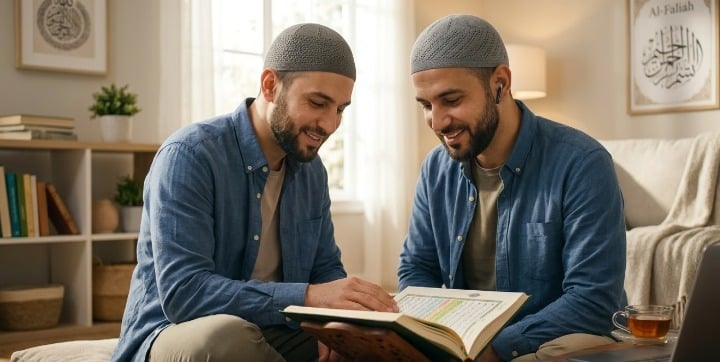
Why is it Important to Read the Quran with Tajweed? (Islamic Perspective)
For millions of Muslims around the world, reading the Holy Quran is a daily act of worship. Whether during Salah (prayers) or in quiet moments of reflection, the words of Allah provide peace and guidance. However, for many non-Arab Muslims living in the West, a critical question often arises: Is it strictly necessary to read the Quran with Tajweed, or is it just to make the recitation sound beautiful?
Many believers assume that as long as they are reading the Arabic letters or a transliteration, their duty is fulfilled. While Allah rewards every effort, viewing Tajweed as a mere “vocal embellishment” is a profound misunderstanding of Islamic tradition.
In this comprehensive guide, we will explore the profound importance of Tajweed from an Islamic perspective, the spiritual and practical dangers of ignoring it, and how mastering this science is the ultimate sign of reverence for the Book of Allah.

1. The Divine Command: Evidence from the Quran
The most direct answer to why Tajweed is important comes from the Quran itself. Allah (SWT) did not just reveal the words; He also revealed the specific manner in which those words should be recited.
In Surah Al-Muzzammil, Allah commands the Prophet Muhammad (PBUH):
“Or add to it, and recite the Quran with measured recitation.” (Quran 73:4)
The Arabic word used at the end of this verse is Tarteel (ترتيلاً). According to the great companion Ali ibn Abi Talib (may Allah be pleased with him), the definition of Tarteel is: “Tajweed of the letters and knowing where to stop.” Therefore, applying the rules of Tajweed—giving every letter its exact pronunciation (Makhraj) and its precise characteristics (Sifaat)—is not an optional luxury. It is a direct fulfillment of a divine command.
What’s the Difference in Tajweed?
2. Preserving the Exact Words of Allah
The Quran is the literal, unadulterated speech of Allah. When the Angel Jibril (Gabriel) descended to teach the Quran to the Prophet (PBUH), he did not just deliver a written text; he delivered an oral recitation. The Prophet (PBUH) then taught it to his companions with the exact same rhythm, elongation (Madd), and pronunciation.
Tajweed is the human mechanism designed to protect this oral tradition. Without it, the Quran would slowly morph as it spread to non-Arab lands. The strict rules of Tajweed ensure that a Muslim in the United States today recites Surah Al-Fatihah exactly the same way a companion recited it in Madinah over 1,400 years ago.
3. The Danger of Changing the Meaning (Lahn)
This is perhaps the most critical practical reason why Tajweed is essential. The Arabic language is incredibly precise. A slight mispronunciation can completely alter the meaning of a word, sometimes with disastrous consequences.
Scholars categorize recitation mistakes (Lahn) into two types:
A. Lahn Khafi (Hidden Mistakes)
These are minor errors, such as failing to hold a nasal hum (Ghunnah) for two full beats or stretching a vowel slightly too long. While these mistakes deduct from the perfection of the recitation, they do not change the meaning of the verse.
B. Lahn Jali (Major Mistakes)
These are severe mistakes that occur when a person substitutes one letter for another or changes a vowel (like reading a Fatha instead of a Kasra). This can completely corrupt the meaning of the Quran.
-
Example 1: The word Qalb (قلب) means “Heart.” If you fail to pronounce the heavy Qaf correctly and say it with a light Kaaf, the word becomes Kalb (كلب), which means “Dog.”
-
Example 2: The word Khalaqna (خلقنا) means “We created.” If pronounced incorrectly with a different throat letter, it can change to Halaqna (حلقنا), which means “We shaved.”
Making a Lahn Jali mistake out of ignorance is forgivable, but intentionally neglecting to learn how to fix it is a serious issue. Applying Tajweed protects you from accidentally uttering words that contradict the majesty of Allah.
4. Elevating Your Spiritual Connection (Khushoo’)
Have you ever listened to a master reciter and felt tears welling up in your eyes, even if you didn’t fully understand the Arabic? That is the power of Tajweed.
The melodic, rhythmic nature of Tajweed is designed to penetrate the heart. When you learn how to apply the rules—when to merge sounds smoothly (Idgham), when to hide them (Ikhfa), and when to stop properly—your recitation slows down. This deliberate pacing creates Khushoo’ (deep concentration and humility). You stop rushing through your daily prayers to “get them over with” and start truly experiencing a conversation with your Creator.
The Reality Check: You Cannot Learn Tajweed Alone
Understanding the importance of Tajweed is the first step. The second, and most crucial step, is taking action.
Many Western Muslims try to learn Tajweed by reading books or transliterations. This is a dangerous trap. You cannot learn a purely vocal science from a silent piece of paper. You might think you are pronouncing the letter Dhaad (ض) correctly, but without a trained ear listening to you, you might be cementing a major mistake (Lahn Jali) into your daily prayers for years.
The Prophet (PBUH) learned orally from Jibril, the companions learned orally from the Prophet, and you must learn orally from a qualified teacher.
Secure Your Recitation with Top Quran Classes
If you live in the US, finding a certified, native Arab scholar in your local community can be incredibly difficult. We have removed that barrier.
At Top Quran Classes, we provide direct access to elite, Ijazah-certified tutors from the Middle East. Whether you are a complete beginner or looking to perfect your advanced rules, our teachers will listen to every syllable you recite, instantly correcting your tongue placement and guiding you toward flawless recitation.
Do not let another day pass reciting the Quran with doubt. Fulfill the divine command and experience the sweetness of perfect recitation.
👉 Click here to explore our flexible, one-on-one Learn Tajweed online courses and book your first private session today!